Have you seen the word Fascisterne online? If you don’t know Danish, it may look confusing. You might think it is a group name, a movement, or just a foreign word.
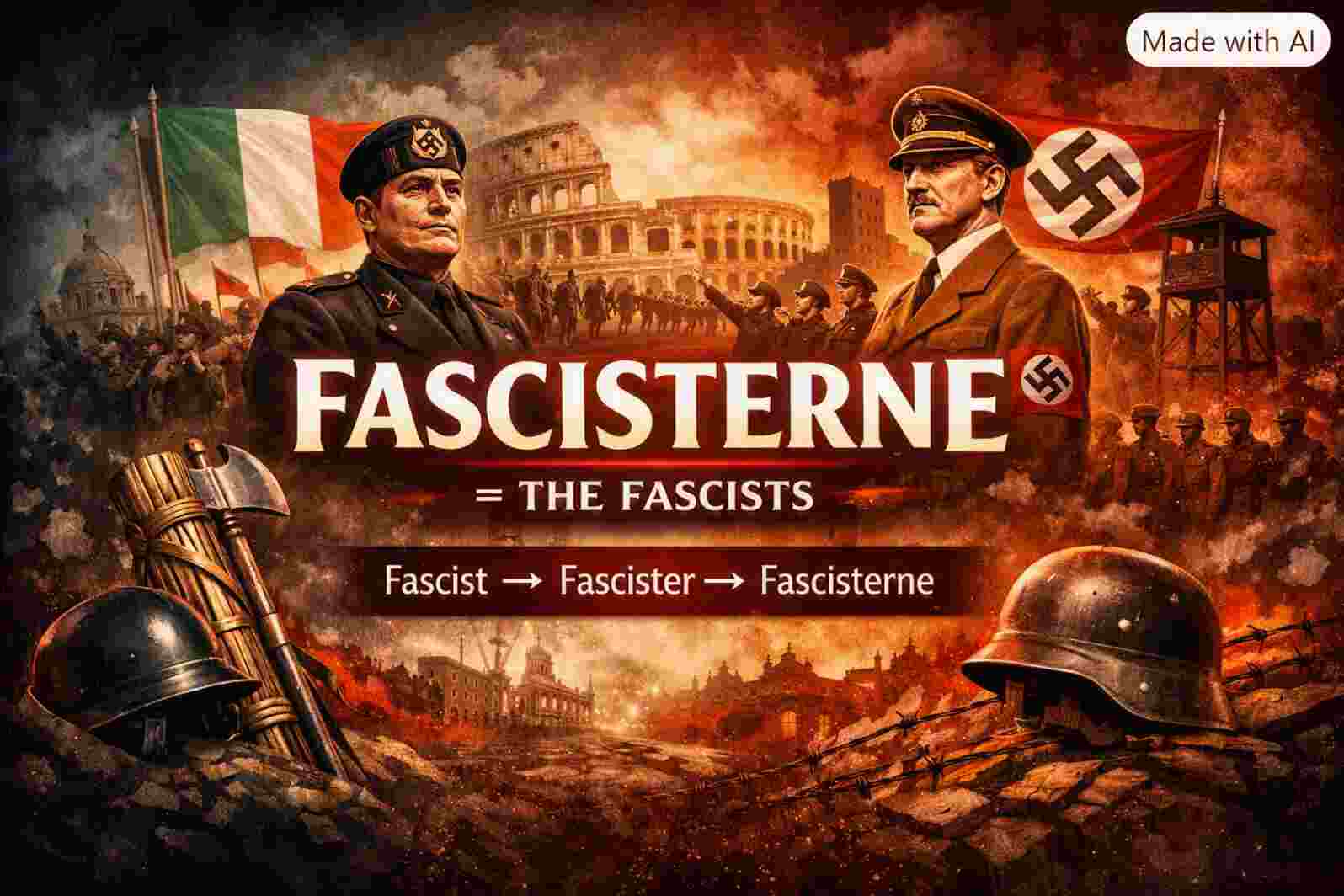
The answer is simple: Fascisterne means “the fascists” in English. Fascisterne is the Danish definite plural form of fascist. The ending ‑erne makes it plural and definite.
What Does Fascisterne Mean?
- Fascisterne = The fascists
- It is the Danish definite plural form of fascist.
In Danish grammar:
- Fascist → one fascist
- Fascister → fascists
- Fascisterne → the fascists
So, Fascisterne is not a new ideology. It is just a Danish word used to describe a group of fascists.
Word Forms
- Fascist – singular, one person.
- Fascister – plural, many people.
- Fascisterne – definite plural, the fascists.
Danish dictionaries document the forms fascist, fascister, and fascisterne.
Is Fascisterne Danish?
Yes. It is a Danish word made from fascist. The word is connected to the Latin fasces, a bundle of rods with an axe that was used as a symbol of authority in ancient Rome. Later, this root became linked to fascism.
What Is Fascism?
Fascism is a political ideology that began in Europe in the early 20th century. It is linked with:
- Strong nationalism
- Authoritarian rule
- Concentrated political power
- Suppression of opposition
The United States Holocaust Memorial Museum explains fascism as a far‑right system that puts the nation above individuals. It became famous in Italy under Benito Mussolini and later influenced Germany under Hitler.
Where Did Fascism Begin?
Modern fascism started in Italy after World War I.
- In 1919, Benito Mussolini founded the Italian Fascist movement, which later became the National Fascist Party.
- In 1922, he led the March on Rome.
- King Victor Emmanuel III invited Mussolini to form a government and appointed him prime minister in October 1922.
- Soon, Italy became a one‑party dictatorship.
Main Features of Fascism
- Strong nationalism – Nation above individuals.
- Authoritarian rule – Power centered on one leader.
- Political repression – Censorship and violence against opponents.
- Militarism – Focus on military strength.
- No pluralism – No competition between parties.
Fascisterne in Danish Writing
You may see Fascisterne in Danish books, articles, or newspapers about Italy in the 1920s–1930s. It simply means “the fascists,” not a special group name.
Fascisterne and Nazi Germany
Fascism and Nazism are related but not the same.
- Fascism → broader ideology.
- Nazism → specific to Hitler’s Germany.
The Holocaust Encyclopedia calls Nazi Germany a fascist government but notes its unique ideas.
Why Do People Search for Fascisterne?
People may find the word while:
- Reading Danish websites
- Translating Danish text
- Studying European history or WWII
- Reading about politics
For English speakers, the simple translation is: Fascisterne = The fascists.
Other Meanings
In modern political writing, “fascist” may also be used to describe a person or movement associated with fascist or authoritarian ideas. The exact meaning depends on the context.
Is Fascisterne the Same as Fascism?
No. They are related but different:
| Word | Meaning |
|---|---|
| Fascism | The ideology |
| Fascist | One person |
| Fascister | Fascists |
| Fascisterne | The fascists |
FAQs
- What does Fascisterne mean? – “The fascists.”
- Language? – Danish.
- Singular form? – Fascist.
- Difference between fascism and fascist? – Ideology vs. person.
- Difference between Fascister and Fascisterne? – “Fascists” vs. “The fascists.”
- Is it a party name? – No.
- Is it linked to Mussolini? – Yes, through Italian Fascism.
Final Thoughts
Fascisterne is a Danish word meaning “the fascists.” It comes from fascist, a person who supports fascism. The word connects to the history of Fascist Italy under Benito Mussolini.
So, when you see Fascisterne in Danish text, just remember: Fascisterne = The fascists.
The word is simple — its history and context make it important.
Want to explore more interesting topics? Visit ourbetterclass.com for more useful articles.