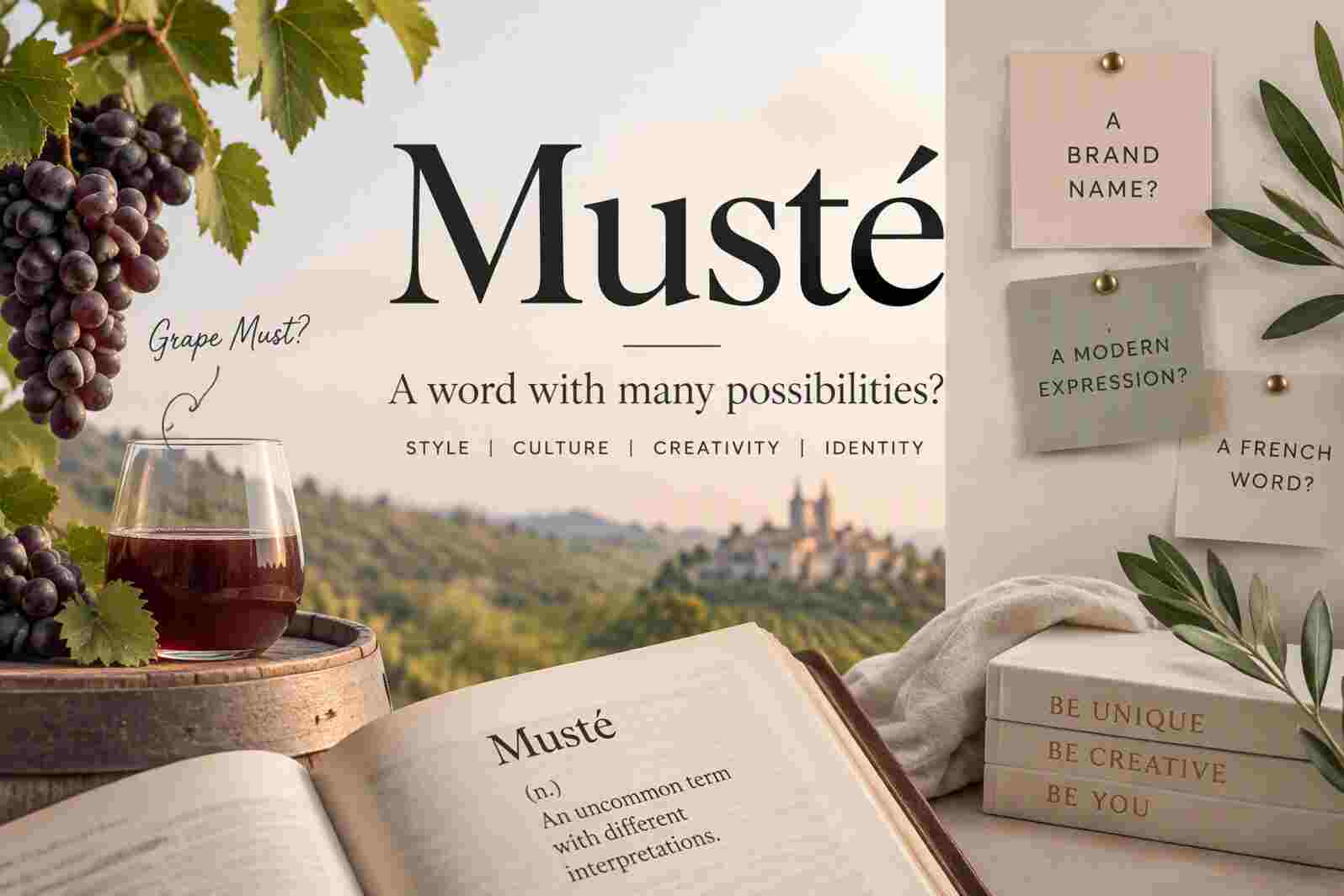
Have you seen the word Musté online and wondered what it means?
You are not alone. The word appears on websites, blogs, social media pages, and sometimes in branding-related content. However, finding a clear definition can be difficult.
The main reason for this confusion is simple: there is no widely accepted dictionary definition of Musté in standard English.
So, what does Musté actually mean?
The answer depends on the context in which the word is used. In many cases, Musté appears to be a creative, stylistic, or branding-related term rather than an established vocabulary word.
This article explains what is known about Musté, where it may come from, and how it is used online.
What Is Musté?
Musté is an uncommon term.
Unlike words found in major English dictionaries, Musté does not have one universally accepted meaning.
The word is often seen in:
- Brand names
- Creative projects
- Lifestyle content
- Social media usernames
- Online articles discussing modern culture
Because there is no single established definition, the meaning of Musté depends on the source using it.
Does Musté Have an Official Meaning?
There is currently no strong evidence that Musté has an official definition in standard English.
This is important because some websites present very specific meanings for the term.
However, the appearance of a word online does not automatically make it an established dictionary term.
In many cases, unusual words become popular because they are memorable, stylish, or unique.
Musté appears to fall into this category.
Is Musté a Real Word?
The answer depends on how the word is being used.
A term can exist and be used online without being a recognized dictionary word.
For example, Musté may be:
- A brand name
- A company name
- A project name
- A username
- A creative expression
- A stylized spelling created for marketing purposes
Because of this, it is more accurate to describe Musté as an uncommon term used in various contexts rather than a standard English vocabulary word.
What Could Musté Mean?
Since the word does not have a fixed definition, people may interpret it differently.
Depending on the context, Musté may be used to suggest:
- Style
- Creativity
- Individuality
- Importance
- Identity
- Modern culture
These are interpretations based on usage rather than official definitions.
When reading any article that uses Musté, it is important to look at how the writer intends the word to be understood.
Is Musté Related to the Word “Must”?
Some people believe Musté may be connected to the English word must.
The word “must” is commonly used to describe something important or necessary.
Examples include:
- This book is a must-read.
- That destination is a must-visit.
- Good planning is a must.
Because of the similar spelling, some brands and writers may use Musté as a creative variation.
However, there is no reliable evidence proving that every use of Musté comes directly from the English word “must.”
Is Musté Related to Wine-Making?
This is one of the most common sources of confusion.
In wine-making, the term must is a well-established word.
It refers to freshly crushed grape juice and other grape materials before or during fermentation.
There is also a French word, moût, which refers to grape must.
Because these words are similar in appearance, some people assume that Musté is another version of them.
However, there is no evidence that Musté is the standard wine-making term.
If you are reading about wine production, the recognized terms are typically:
- Must
- Grape must
- Moût
Not Musté.
Is Musté a French Word?
Many people assume Musté is French because of the accented letter é.
However, an accent alone does not prove that a word comes from French.
The recognized French wine-related term is moût, not Musté.
In many modern brands and creative projects, accents are added simply to create a distinctive appearance.
Therefore, it would be inaccurate to automatically describe Musté as a traditional French word.
Why Is Musté Becoming Popular Online?
There are several possible reasons.
1. It Looks Unique
The accent makes the word stand out.
2. It Is Easy to Remember
Short words often work well for branding and marketing.
3. It Feels Modern
Many businesses and creators prefer names that sound distinctive.
4. It Creates Curiosity
People search for unfamiliar words they encounter online.
5. It Works Well as a Brand Name
Unique terms are often easier to use for products, websites, and creative projects.
How Should You Understand Musté?
The best approach is to examine the context.
If It Appears on a Brand Website
It may simply be a company or product name.
If It Appears in Creative Content
It may represent an idea, style, or artistic identity.
If It Appears in Social Media
It could be a username, personal name, or online identity.
If It Appears in Wine Content
Check whether the writer actually means “must” or “moût.”
Context is the key to understanding the intended meaning.
Common Misunderstandings About Musté:
Musté Has One Official Definition
No widely accepted definition exists.
Musté Is a Standard English Word
There is currently no evidence that it is a commonly recognized English vocabulary word.
Musté Is the French Word for Grape Must
The recognized French term is moût.
Musté Always Means Something Stylish
This is only one interpretation found in some online content.
Musté Has a Proven Origin
Its exact origin remains unclear.
Frequently Asked Questions:
What does Musté mean?
Musté does not have one universally accepted meaning. Its interpretation depends on the context where it is used.
Is Musté an English word?
It appears in English-language content, but it is not widely recognized as a standard English dictionary word.
Is Musté a brand name?
In some cases, yes. Businesses, creators, and projects may use Musté as a name or identity.
Is Musté related to wine-making?
People sometimes make this connection because of the word “must,” but Musté is not the standard wine-making term.
Is Musté French?
There is no clear evidence that Musté is an established French word.
Why is Musté difficult to define?
Because different websites and creators use the term in different ways.
Final Thoughts:
Musté is an uncommon and context-dependent term.
It does not currently have a universally accepted meaning in standard English. Most uses appear to be connected to branding, creative expression, online identity, or stylistic naming rather than a formal dictionary definition.
If you come across the word Musté, the safest approach is to look at the context in which it appears.
Understanding the source, topic, and purpose of the content will usually provide a clearer explanation than relying on a single fixed definition.
Want to explore more interesting words, meanings, and trending terms? Visit ourbetterclas.com for more simple and useful guides.